German Chancellor Angela Merkel has agreed to answer the 10 most popular questions made by German citizens via the Internet over a period of three days on YouTube. This initative seeks to engage in dialogue with the citizens.Saturday, November 19, 2011
Angela Merkel reaches out to citizens via YouTube
German Chancellor Angela Merkel has agreed to answer the 10 most popular questions made by German citizens via the Internet over a period of three days on YouTube. This initative seeks to engage in dialogue with the citizens.Saif al-Islam Gaddafi captured in Libya

According to transitional government officials, Saif al-Islam Gaddafi has been arrested in Libya’s southern desert region. Muammar Gaddafi’s second son, on the run since the fall of the regime, was detained in good health along with several bodyguards by fighters near the town of Obari while trying to flee to neighbouring Niger, assured a militia commander. The International Criminal Court (ICC) has charged him with crimes against humanity for the fierce repression against civilian protesters in February, although Saif al-Islam claimed his innocence last month. Nevertheless, Libyan officials are not willing being Saif al-Islam before the ICC in The Hague. The Libyan Justice Minister has claimed that Saif al-Islam will face trial in Libya with the presence of international observers, in coordination with the ICC.
Sources:
http://www.guardian.co.uk/world/2011/nov/19/saif-al-islam-gaddafi-captured
http://www.aljazeera.com/news/middleeast/2011/11/20111119111936535209.html
This piece of news raises the question of whether international justice should step in when judging leaders in war-torn countries. If Saif al-Islam Gaddafi faces justice at home, the people who have fought for a new Libya would probably feel that the whole war was worthwhile. But is the current Libyan institutional and legal framework strong enough to hold such a trial? The fact that Saif al-Islam has been captured instead of executed without a fair trial shows that Libya is somehow willing to adjust to international standards, thus avoiding another controversy like the one surrounding Gaddafi’s arbitrary killing. On the other hand, if Saif al-Islam was brought before the ICC, this recently established “world court” would gain voice and support from numerous states, widening its now limited scope of action. A first step, even, towards the end of impunity.
Thursday, November 17, 2011
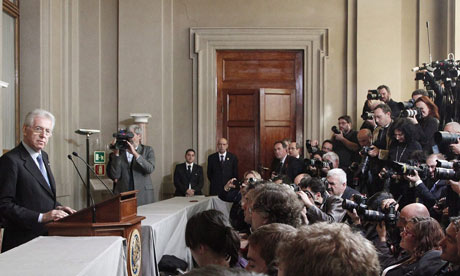
Ciao “bunga bunga”, Hello “banking banking”
Wednesday, November 16, 2011
ZAPATERO'S STRATEGY: STAY OUT OF THE NEWS

Jose Luis Rodriguez Zapatero, Spain president, is following a “keep your head down fashion”. He tries to stay on the background of most of the international meetings and he tries that Spain is not mentioned in the economic reports from Brussels and Frankfurt. Spain, Italy, Ireland and Belgium do like the same kind of fashion. Now they don’t want to be noticed so they are wearing the “keep your head down” clothes. However, this fashion can work, but not if the figures stop adding up as they are doing. The problem is that Zapatero is attending to an event where this kind of fashion is not appropriate; he is attending to an economic crisis, which does not match with the political instability.
In my opinion Zapatero is following this behavior because he is scared about the Spanish opinion. He is scared because of the elections this Saturday. He knows that the PSOE is going to get one of the lower results of its history. He knows that a great part of Spain blames him for the crisis, so if Spain gets no mentioned at all on the reports, maybe some population would think about who to vote. I think that, the crisis, it is not just Zapatero’s fault. We are not where we are, just because of the actions of an individual, because we belong to a global interdependent economic system. However I do agree that the actions of the socialist government in economy have not been the most appropriate ones and that Zapatero has not have the nerves that were needed in such a situation. He feels the rejection of a country and that is pretty hard to assume so now he tries to say goodbye without making noise.
Inman, Philip. Zapatero's strategy for Spain: stay out of the news. The Guardian
http://www.guardian.co.uk/business/economics-blog/2011/nov/11/spain-keeps-low-profile-amid-eurozone-crisis
Indonesia’s Democracy: Too Early to Make an Example from It
The visit of President Obama to Jakarta next Thursday is making Indonesia be in the front news. The visit of the US President to the country where he spent part of his childhood is more than just an emotional courtesy visit. It is a way to reestablish the Indonesian- American relations that will make it possible for the US to counteract China’s influence in the Asia Pacific region. It is also a way to show the world, worried about the future of the countries living the "Arab Spring", the example of Indonesia as an Islamic country that made a successful transition to democracy after dictator Suharto was overthrown ten years ago.
However, even if it is true that the democratic reforms have being successfully implemented (now the media is more free, repressive laws have been wiped out, and there are elections to chose the country leader), it is too early to raise Indonesia’s case as such a perfect example of democratization. Why? Because there is a repression going on against Papuan citizens, and against Christians. They, both inhabitants of the Papua Island, claim for their independence saying that the ballot carried out by the UN in times of their decolonization from the Dutch was a sham. Now, every time they decide to protest, there is a disproportionate state reaction that has even end up killing some activists or putting some of them in jail for the rest of their lives.
I think this news shows us how intricate international issues are and how do countries relate to each other. We can also see how a relatively small country, like Indonesia can be, first of all, an important location for US interests, and at the same time how the country is being used as and example that links directly with the top topic in the last few months: the Arab Spring. I coincide with the author when he says that maybe it is too soon to consider Indonesia a perfect example of democratization when they are still acting as a non-democratic government in many cases. However, I think that looking at Islamic countries that have already taken the steps to become democracies can be a good way to approach the future of the revolutions that seem to be causing so many headaches.
http://www.taiwannews.com.tw/etn/news_content.php?id=1760462
Tuesday, November 15, 2011
AFGHANS IN TRANSITION
A recent survey taken by a varied number of Afghans (from rural areas and urban areas, different ages, etc.), directed by The Asia Foundation, has provided some interesting answers. In this survey they identify the main problem to be right now insecurity, but they believe in the improvement of the Afghan Army and Afghan National Police. They also support their government’s efforts in trying to negotiate and talk with the Taliban and other armed opposition groups. The Afghan people are also aware of the development and reconstructions projects. They see progress in the quality of their lives, appreciate the services they receive from their government, and continue to support equal rights regardless of gender, ethnicity or religion. Furthermore a big percent support educational opportunities for women.
I think that the view of the Afghan people and their support is essential for the progress of the country. However, it is worrying that despite a lot of people are saying that the country is moving in the right direction, those saying the country is moving in the wrong direction have increased by 8 percent over the past year. We should hope that none of these advances will be lost in the current Afghan transition.
Source: The New York Times
Monday, November 14, 2011
Third Post
You can begin to post your third blog. The blog will close on Thursday, November 24, 12:00PM (Noon).
Dr. Fuentes